Knees Over Toes: Breaking One of the Most Common Rules
June 2026
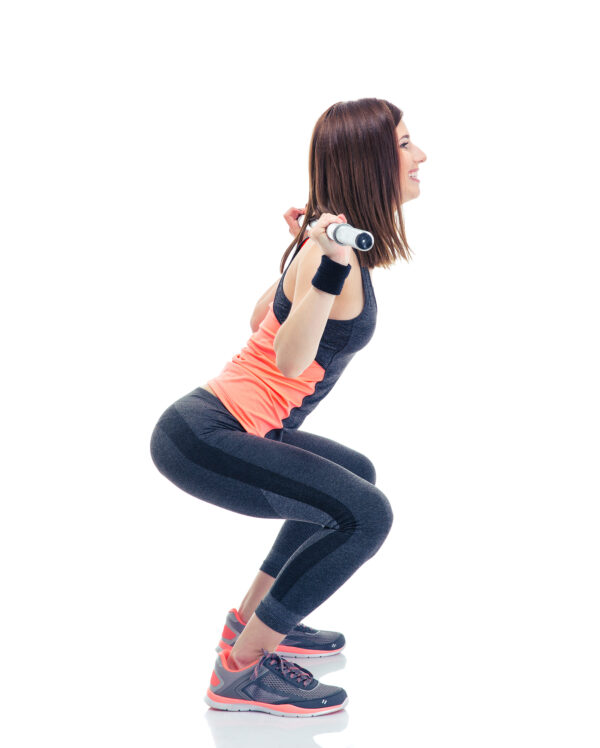
Your knees are designed to move over your toes. This functional motion is necessary in many common movements, including rising from a chair, using stairs, deep lunging and squatting, hiking, and more. Unfortunately, the message to keep the knees inline or behind the toes is still pervasive in gyms, yoga studios, and on athletic fields. Where did this recommendation come from and should we still follow it?
Research Supports Breaking the Knees Over Toes Rule
Guidance to prevent the knees from traveling over the toes seems to have evolved from research by Karl Klein, PhD in 1961, which found that deep squats increase knee ligament laxity. Although Klein’s study did not specifically measure how far the knees flexed over the toes, further research in the 1970s examined this variable and determined that allowing the knees over the toes increased shearing forces and torque on the knee joint. Unfortunately, much of this original research was not readily available online.
In 2003, a landmark study by Fry et al, added surprising new information. This study measured both knee and hip torque in men during a barbell squat. Two experimental conditions were set-up. (1) A restricted squat where a vertical board was placed just in front of the subjects toes at the end of their shoes which stopped forward knee movement over the toes. (2) An unrestricted squat where the knees were free to move forward as much as necessary.
Results of the study confirmed that knee torque is decreased when the knee cannot move past the toes. Specifically, knee torque decreased from 150.1 Nm in the unrestricted squat to 117.3 Nm in the restricted squat. Interestingly, the opposite response was observed at the hip. Hip torque rose from 28.2 Nm during the unrestricted squat to 302.7 Nm during the restricted squat. Wow! The hips are under tremendous load when forward knee movement is limited.
Additionally, the study discussed that limiting forward knee flexion caused subjects to lean forward more which increases shear forces on the lumbar spine. To summarize, the research found that restricting forward knee movement over the toes slightly decreased knee forces while greatly increasing hip torque and creating consequent postural changes (forward lean) that raised the load on the low back. On the other hand, unrestricting forward knee movement elevated knee forces though they were within the capabilities of the joint, decreased hip torque, and allowed for more upright posture and less strain on the lower back.
Hence, the study concludes that “it may be advantageous to permit the knees to move slightly past the toes in a parallel squat position.” The authors include a caveat that this advice is for people with healthy knees that do not have any pathological conditions such as meniscus or ligament injury, tracking disorders such as chondromalacia, or other such conditions. However, being a person who has had meniscus surgery and has followed the knees behind toes rule I have experienced additional body repercussions from taking this restricted squatting approach. Read on before deciding if the knees behind toes rule is right for you.
Functional Movement and Strength Losses
Restricting movement of the knees past the toes also limits ankle flexion (dorsiflexion) range of motion. Dorsiflexion requires flexing the ankle to bring the toes up toward the shin. This motion requires lengthening of the structures in the back and bottom of the foot along with the posterior calf muscles. These tissues tend to be short and tight in many of us due to all our upright activities (walking, standing, running, hiking, etc.) which are repeatedly loading these areas. Without practicing this functional movement, we tend to lose it. Use it or lose it! And, a loss of dorsiflexion often leads to compensation, muscle imbalances, postural changes, and altered movement mechanics all of which can be precursors to injury.
Specifically, quadriceps strength is impacted. To engage the quad muscles adequate dorsiflexion is required. Always keeping the knees behind toes is often not going to activate these muscles. An additional point of interest that the Fry study points out is that most of the shear forces during a squat are in the posterior chain (back of the body). I had not fully appreciated this fact until my recent squat experience at the gym.
My Story About Squatting Technique
I am not able to fully squat properly, yet. However, with careful attention to my form (knees behind toes) I thought that performing a limited range of motion barbell squat was safe for my body. However, a few months ago I found out that I was wrong. Or perhaps it was the technique I was using that was at least partially to blame?
Here’s what happened: I had the barbell on my back and lowered down on my ninth repetition. As I began to press up I felt a sudden and odd sensation in my right lower back that gave me the message to stop which I did. My back felt strange and a bit tighter than before squatting but I was able to do a few additional dumbbell exercises with no issue before ending my workout.
To be clear, I have had three knee arthroscopes on the left knee, a hip arthroscope on the left side, and manage ongoing right lower back tightness. So, it would appear from the research above that how I squat without irritating any of these sensitive areas may be a challenge. As I mentioned above, I was following the knees behind toes rule to protect my knee and have had no knee pain when squatting. While this advice is still appropriate for some knee conditions as mentioned, in my case, the increased stress on my hips and low back proved to be detrimental.
As it turns out the back stiffness following my squat workout lingered for weeks. After exhausting my knowledge toolkit, I collaborated with a physical therapist on the issue. Upon conducting the initial exam, you won’t be surprised to know that my dorsiflexion was extremely limited, especially on the left, my feet were very tight, and both my quads were short and weak. Hence, when I was squatting with my knees behind my toes nearly all the shear force was going through the posterior chain of my body which overloaded my lower back. Evidently, I needed to consider breaking this long-time rule of movement. But how?
How to Safely Train Knees over Toes Movements
If you have been following the knees behinds toes rules as I have, here is some guidance to begin altering your motion to free your knees forward:
- Lengthen your quads, calves, and feet to increase the mobility of these tissues through stretches, fascia release (roller, balls, etc.), and similar movements.
- Focus on strengthening exercises that emphasize dorsiflexion such as lunges, step ups, step downs, and squats. Pay attention to driving your knee forward with these movements and gently allowing it to move gradually past your toes.
- Start with your own bodyweight as the only resistance and progressively add weight slowly.
- Begin with one set of multiple repetitions, 8-15. Just like with adding weight, progress slowly and only increase one variable (weight or sets/reps) at a time. Repeat that load for 1-2 weeks (2-6 workouts) before advancing either variable.
Here’s an example progression:
- 1 set of 10 reps with body weight
- 1 set of 12 reps with body weight (Reps are increased)
- 1 set of 12 reps with 5 pound weights (Weight is increased)
- 1 set of 15 reps with 5 pounds (Reps are increased)
- 2 sets of 8 reps with 5 pounds (Sets are increased with 1 additional rep added)
- 2 sets of 8 reps with 8 pounds (Weight is increased)
- And so forth. . .
Following a slow, progressive approach allows the tissues to safely adapt and while regaining essential function and strength.
Conclusion
Allowing the knees to pass the toes is a normal, natural, and necessary motion for daily living and athletics. Failing to practice this functional movement can lead to losing it and a predisposition for injury. Research findings indicate that keeping the knees behind the toes reduces torque at the knees but increases the strain on the hips and low back. In addition, always keeping your knees behind your toes can reduce dorsiflexion mobility and quad strength.
Your decision on whether to break the knees over toes rule depends on your body with the primary concern being knee health. A slow, progressive approach of adding this functional movement into your routine is advised.
Play Witout Pain!
Join The Pain Free Athlete community.
You will receive online newsletters, notifications of upcoming events, and exclusive special offers only available to subscribers.